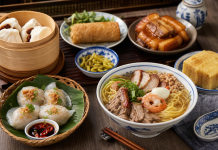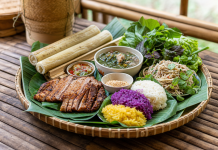



Balancing the five flavors—sweet, sour, salty, bitter, and spicy—is a useful way to think about Vietnamese cooking. The goal is not to make every flavor equally strong. It is to give a dish a clear direction while keeping any one sensation from overwhelming the rest.
The Vietnamese topic name, Cân bằng hương vị trong nấu ăn Việt Nam, describes this work of balancing flavor in Vietnamese cooking. For the home cook, it becomes a practical question: what does this bite need? Sometimes the answer is acidity or salt. Other times, the best adjustment is less seasoning, a little dilution, or a fresh accompaniment.
What Does Flavor Balance Actually Mean?
A balanced dish can still be distinctly sour, gently sweet, or quite spicy. Balance means that its supporting flavors make the main character enjoyable rather than compete with it. A dipping sauce does not need to taste like a broth, and a bitter vegetable does not need to lose all its bitterness.
The five-flavor framework is a cooking tool, not a complete scientific map of taste. Spicy heat is a sensation rather than a basic taste, and savory depth also matters. Aroma, temperature, texture, and the proportions in each bite affect the result, too.
For a Vietnamese meal, it is useful to judge both the individual component and the assembled bite. A strongly seasoned sauce may make sense in small amounts with plain rice or noodles, even if it tastes too intense by itself.
Understanding the Five Flavors
Sweet: Roundness Without a Sugary Finish
Sweetness can soften the perception of sharp acidity, bitterness, or chile heat. It may come from added sugar or from ingredients that already taste sweet. Its job does not have to be obvious: a small amount can round out a sauce without making sweetness the main impression.
When adjusting a savory preparation, add sweetener gradually and dissolve it fully before tasting again. If the dish begins to taste sugary, more salt or acid may only create a louder mixture. Diluting with an appropriate unsweetened base is often a better next step.
Sour: Brightness and Definition
Sour ingredients such as lime juice or vinegar can make a rich or muted bite feel more lively. Acidity is especially useful when food tastes heavy but already has enough salt. It provides contrast rather than simply increasing seasoning.
Different sour ingredients also contribute different aromas, so they are not always interchangeable in effect. Add a little at a time. If a preparation is unpleasantly sour, consider dilution before trying to cover the sharpness with a large amount of sugar.
Salty: Seasoning and Concentration
Saltiness helps other flavors register clearly, but it is easy to overshoot when several seasoned ingredients are combined. Fish sauce, for example, contributes both saltiness and savory flavor. Adding it changes more than one part of the dish.
Before adding another salty ingredient, consider what is already present and how the food will be served. A spoonful of broth, a dipping sauce, and a bite of seasoned food with rice require different judgments. Reducing a liquid also concentrates its seasoning, so taste again after simmering.
Bitter: Contrast Rather Than a Defect
Bitterness can provide a useful counterpoint to sweetness and richness. Bitter vegetables and some leafy ingredients do not necessarily need to be made neutral. The question is whether their bitterness is pleasant within the whole bite.
Do distinguish an ingredient’s natural bitterness from a scorched flavor. Burned garlic or badly scorched seasoning cannot reliably be repaired by adding sugar. If burning is the problem, replacing the affected component may be more effective than trying to balance it.
Spicy: Heat With a Purpose
Chile heat can add energy, but it should suit the dish and the people eating it. Because heat can linger, repeated tasting may make small differences harder to judge. Pause between adjustments rather than adding chile in quick succession.
Offering chile separately is a practical option when preferences differ. If a sauce is already too hot, adding more of its unspiced base can reduce the concentration. Sugar may soften the impression of heat, but it does not remove the chile.
A Reliable Method for Balancing the Five Flavors
- Choose the intended character. Decide whether the preparation should be bright, savory, gently sweet, bitter, or chile-forward. Without that direction, every adjustment can pull it somewhere new.
- Taste at a realistic serving temperature. When practical, judge the food close to how it will be eaten, rather than only straight from a hot pan or refrigerator.
- Name the problem precisely. “Too salty” is more useful than “not right.” Likewise, distinguish blandness from heaviness, excess sweetness, or a lack of aroma.
- Change one thing at a time. Make a small adjustment, stir thoroughly, and taste again. This makes it easier to understand what helped.
- Test the complete bite. Try the sauce with the food it will accompany. Include rice, noodles, vegetables, or herbs if they are part of the serving.
- Stop before every flavor becomes obvious. Supporting ingredients do not all need to announce themselves. A clear, enjoyable result is more important than checking five boxes.
A Proposed Dipping Sauce Exercise
The following small-batch exercise illustrates adjustment; it is not presented as a traditional standard or a tested formula. Ingredient strength varies, especially with fish sauce, citrus, and chiles.
Suggested Starting Quantities
- 2 tablespoons water
- 1 tablespoon fish sauce
- 1 tablespoon lime juice
- 2 teaspoons sugar
- A small amount of finely chopped fresh chile, optional
Stir the water and sugar until the sugar dissolves, then mix in the fish sauce and lime juice. Taste a small amount with plain rice or unseasoned cooked vegetables before adding chile.
If the sauce tastes too concentrated, add water by the teaspoon. If it needs more brightness, add lime juice in small drops. If the acidity feels too sharp, try a small pinch of sugar, dissolve it, and reassess. Add more fish sauce only if the assembled bite needs additional saltiness and savory depth.
This exercise does not need a bitter ingredient. Its purpose is to show how several flavors interact, not to force all five into one bowl. Bitterness could come from an accompanying vegetable, or it might not be part of that serving at all.
Balance the Meal, Not Just the Pan
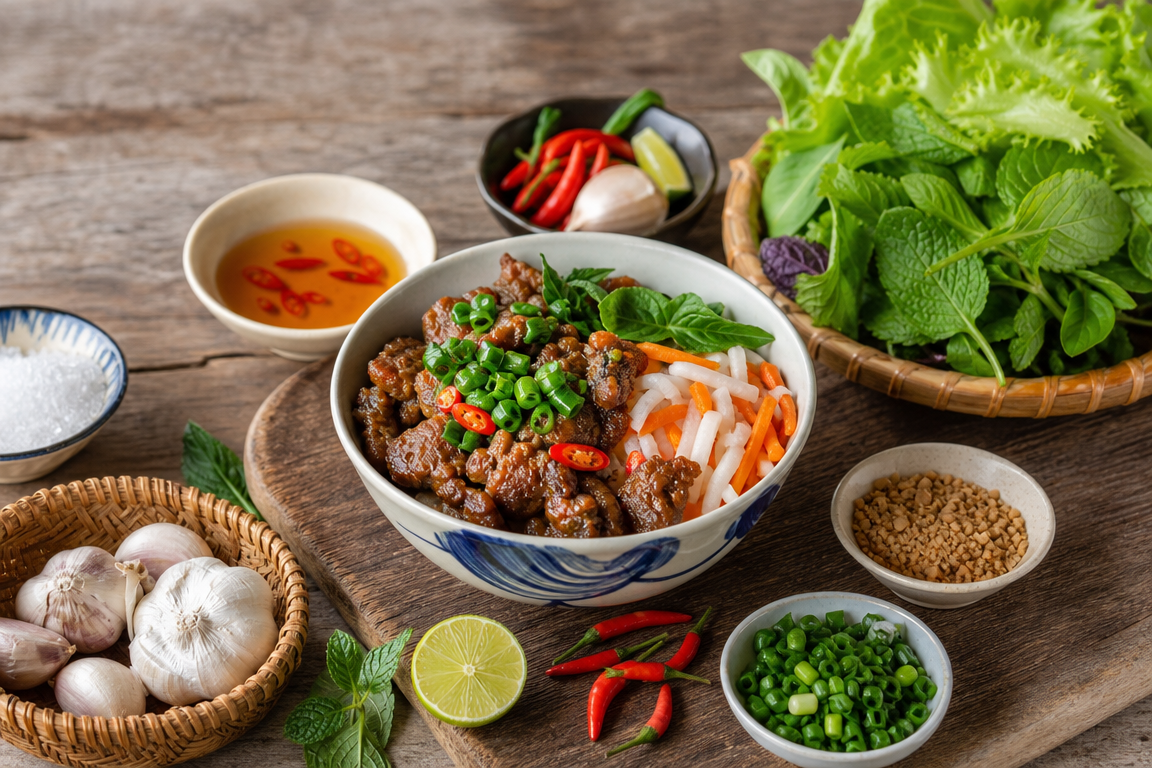
A useful approach to Vietnamese food is to consider how the components work together. Plain rice or noodles can soften the impact of concentrated seasoning. Fresh vegetables can add crunch and contrast. Herbs contribute aroma, which may make a bite feel more complete without additional sugar, salt, or acid.
Proportions matter. A small drizzle of sauce can complement a bowl, while several spoonfuls of the same sauce can overwhelm it. Before changing the recipe, check whether the problem is simply how much of each component reaches the fork or spoon.
There is no need to assign a single fixed flavor ratio to Vietnamese cuisine. For practical cooking, judge the preparation in front of you rather than assuming that one preferred balance should apply to every dish.
Common Adjustment Mistakes
- Using sugar as a universal fix. It can soften some harsh impressions, but it can also leave a dish both too sweet and too salty.
- Adding acid whenever food tastes flat. First check salt, aroma, dilution, and serving temperature. Acidity is not always the missing element.
- Trying to cancel excess salt. Sugar and lime do not remove salt. Adding unsalted ingredients or replacing part of the liquid is usually more direct.
- Forcing bitterness into a finished dish. The five-flavor framework does not require five separate ingredients or five equally noticeable sensations.
- Seasoning without tasting the accompaniments. A component can seem correct alone and become excessive when combined with another seasoned element.
Frequently Asked Questions
Does every Vietnamese dish need all five flavors?
No. Use the framework to understand contrast and make deliberate adjustments, not as a requirement that every dish taste sweet, sour, salty, bitter, and spicy.
What should I do when I cannot tell what is missing?
Set aside a small sample and adjust only that portion. Try a few drops of acid or a small amount of seasoning, depending on the suspected problem. Compare it with the unchanged food before adjusting the whole batch.
Can a mild dish still be balanced?
Yes. Balance does not depend on intensity or chile heat. A mild preparation can have clear seasoning, appealing aroma, and enough contrast to remain satisfying.
What is the most important habit to develop?
Taste in context. A balanced Vietnamese meal is experienced in bites, not as a list of isolated ingredients. Small, deliberate adjustments are more useful than chasing a fixed ratio.