

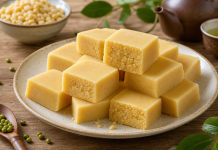



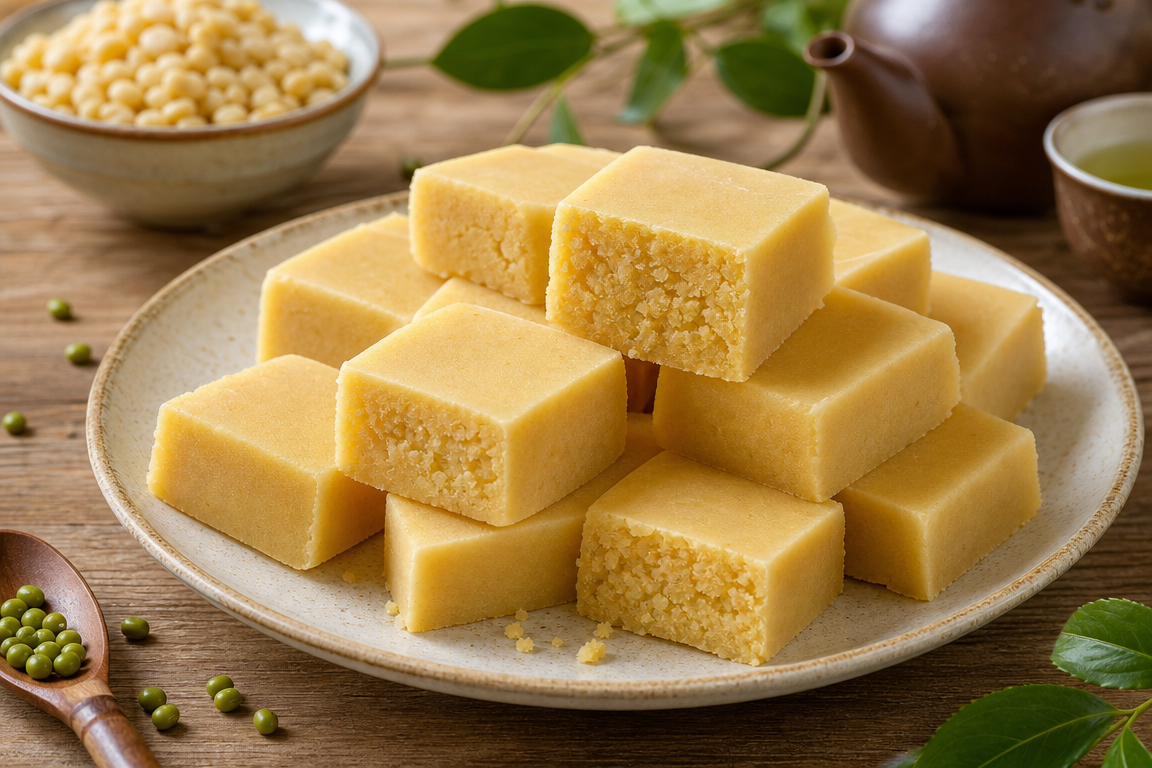
Vietnamese green bean cake, called bánh đậu xanh, is the focus of this small-batch recipe. Here, “green bean” refers to mung beans, not the long green vegetables served as a side dish. Split, hulled mung beans are yellow and make a practical starting point for a smooth bean mixture.
This proposed home-kitchen version combines steamed mung beans with powdered sugar, neutral oil, and a little salt, then presses the mixture into small squares. It is intended to produce tender, compact cakes rather than a fluffy, oven-baked dessert. The finished texture depends on how thoroughly the beans are cooked and how much moisture is removed before shaping; this is not presented as a historically authentic formula.
Recipe Overview
- Yield: 16 small squares
- Preparation: 4 hours 25 minutes, including a 4-hour soak and about 25 minutes of hands-on preparation
- Cooking: About 50 minutes: 30 minutes steaming and 20 minutes cooking the bean mixture
- Cooling: About 30 minutes, separate from preparation and cooking time
- Equipment: Steamer, heatproof shallow dish, fine-mesh sieve or potato masher, nonstick skillet, spatula, and a small square pan or food-safe mold
The cooking times are estimates. Bean tenderness and the final mixture’s consistency matter more than an exact minute count.
Ingredients
- 200 g dried split, hulled mung beans, about 1 cup
- 90 g powdered sugar, about 3/4 cup, sifted if lumpy
- 50 g neutral oil, such as sunflower or canola oil, about 3 tablespoons plus 2 teaspoons
- 1/8 teaspoon fine salt
- Water, as needed for rinsing, soaking, and the steamer
Choose split, hulled mung beans rather than whole green mung beans. Whole beans retain their skins and will not give the same smooth, pale mixture with these instructions. Powdered sugar is useful here because it blends into the beans without leaving the noticeable crystals that granulated sugar can leave.
How to Make Green Bean Cake
- Rinse and soak the beans. Rinse the mung beans in several changes of water, then place them in a bowl with enough fresh water to cover them by about 2 inches. Soak for 4 hours. This soaking period is included in the preparation time.
- Drain and prepare the steamer. Drain the beans well and spread them in a shallow heatproof dish that fits inside your steamer. Add water to the steamer base according to its instructions, keeping the water below the dish. Bring the water to a steady simmer.
- Steam until very tender. Set the dish in the steamer, cover, and steam for about 30 minutes. Check the water level as needed so the base does not boil dry. A bean should crush easily between a spoon and the side of the dish. If the center is still firm or chalky, continue steaming until tender.
- Mash while warm. Mash the drained, warm beans thoroughly. For a finer texture, press them through a fine-mesh sieve with the back of a sturdy spoon. Break up any visible lumps before moving to the skillet.
- Cook off excess moisture. Transfer the mashed beans to a nonstick skillet over low heat. Cook for about 15 minutes, stirring and folding frequently to release steam and prevent sticking. The mixture should become noticeably drier and gather together when pushed with the spatula. Avoid browning it.
- Add the sugar, oil, and salt. Stir in the powdered sugar, oil, and salt. Continue cooking over low heat for about 5 minutes, folding until evenly combined. The full skillet stage takes about 20 minutes. The warm mixture should look matte rather than wet and should hold together when a spoonful is pressed firmly. Do not touch it until a small sample has cooled enough to handle safely.
- Press into shape. Line a roughly 6-inch square pan with parchment paper. Transfer the warm mixture to the pan and press it firmly into an even layer using the back of a spoon or a flat-bottomed cup. Pay particular attention to the edges and corners. Alternatively, pack the mixture firmly into small food-safe molds.
- Cool and portion. Leave the pressed cake to cool for about 30 minutes, or until it feels firm enough to lift and cut. Lift it out with the parchment and cut into 16 squares with a thin knife. Small cracks are possible because this mixture has no flour or egg binder.
Tips for a Smooth, Cohesive Cake
Cook the beans fully before drying them
Drying cannot fix undercooked beans. If they resist mashing or leave hard flecks, return them to the steamer before adding sugar and oil. Fully tender beans are easier to turn into a fine, even mixture.
Judge moisture before pressing
A wet paste may spread or stick instead of cutting cleanly. Give it a little more time over low heat, stirring constantly. If the mixture seems dry but falls apart when compressed, first try pressing a small portion more firmly. If it still will not bind, work in additional oil a teaspoon at a time. Any extra cooking or ingredient adjustment will change the estimated timing or quantities.
Use pressure rather than extra liquid
Firm packing helps the cakes keep their shape. Avoid adding water simply because the mixture looks crumbly in the pan; loose crumbs may still bind when compressed. Test a small spoonful before adjusting the whole batch.
Serving Suggestions and Variations
Serve the cakes in small portions once cooled. Unsweetened tea or coffee offers a simple contrast to their sweetness. Lift each square with a small spatula if it feels delicate.
- Less sweet: Try 75 g powdered sugar instead of 90 g. Check the consistency before molding, since changing the sugar also changes the balance of the mixture.
- Lightly vanilla-scented: Add 1/4 teaspoon vanilla extract with the sugar. This is an optional flavor variation, not part of the base formula.
- Individual shapes: Use small food-safe molds instead of a square pan. Pack each one firmly and unmold carefully.
Frequently Asked Questions
Can I use regular green beans?
No. This recipe needs dried split, hulled mung beans. Fresh or frozen green beans have a different structure and moisture content and are not a substitute.
Does this cake need baking?
No. In this proposed version, the beans are steamed, cooked down in a skillet, and pressed into shape. There is no oven stage or raising agent.
Why is my mixture too soft?
It may contain too much residual moisture. Before molding, cook it a little longer over low heat, stirring frequently. Cooling also firms the mixture, but it will not fully correct a visibly wet paste.
How should I store the cakes?
Because this version starts with cooked beans and its final moisture can vary, do not assume it is shelf-stable. Refrigerate cooled cakes promptly in an airtight container and use within 3 to 4 days. Separate layers with parchment and let individual portions lose their refrigerator chill briefly before serving.